
Three Big Reasons to Choose UpStage Over Arts People / Neon One
The Data That Turns Browsers Into Buyers
Patron revenue profiles don’t exist in Arts People / Neon One: no seasonal spend, no product history, no signal that a loyal buyer is drifting away.
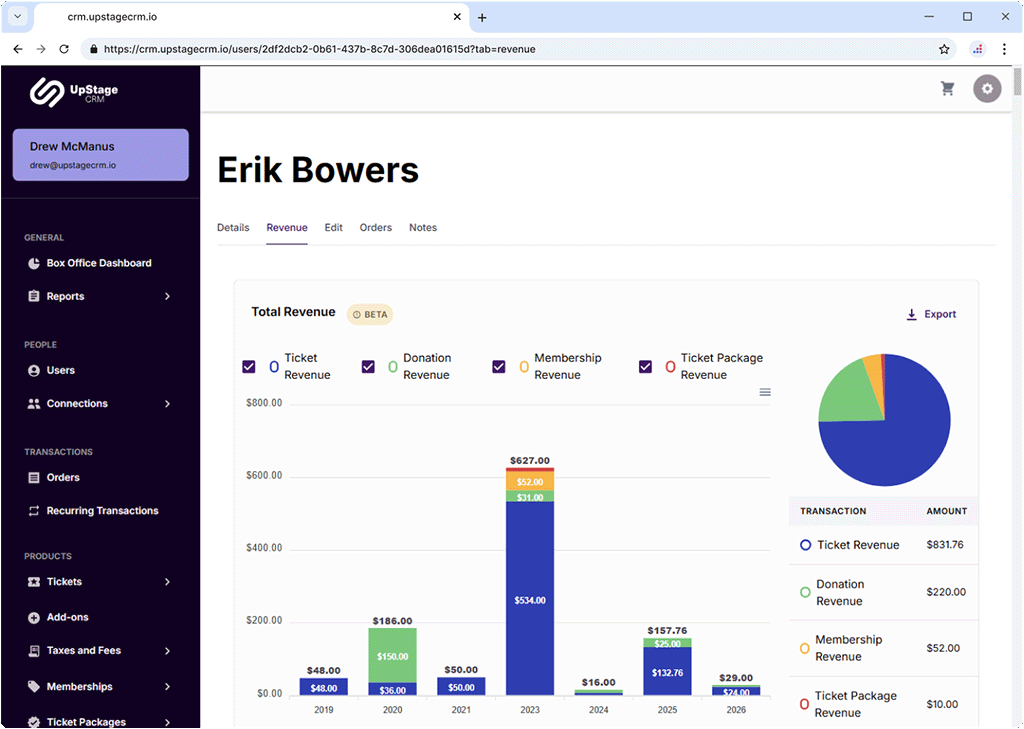
UpStage automatically builds a complete revenue profile for every patron, tracking seasonal spend, product averages, and highest spend by category, so your team knows exactly who is ready for a membership pitch and who hasn’t bought a ticket in two seasons.
Combined with standard first-time, repeat, lapsed, and reactivated buyer reports and direct Mailchimp integration with tagged patron segments, UpStage turns your patron database into a targeted sales engine.
Your Staff’s Day, Handed Back
When your patrons log in to manage their tickets, they land in a Neon One portal: there is no dedicated patron account experience built around your organization, and no portal at all in Arts People.
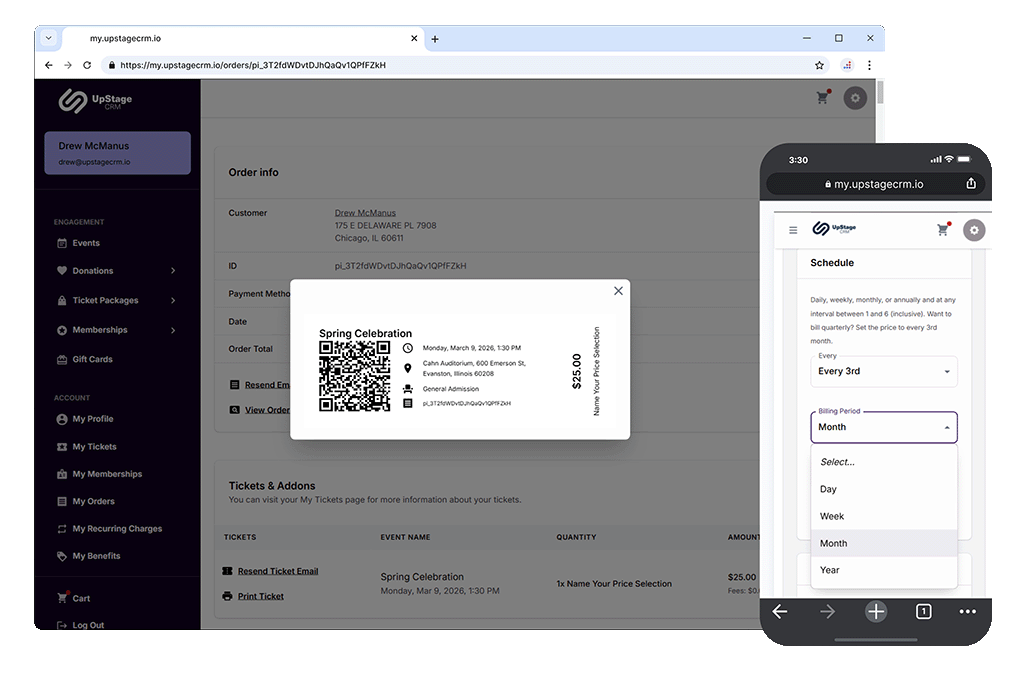
UpStage gives every patron a dedicated patron portal where they can access their tickets, review their order history, and resend their own confirmations any time without contacting your staff.
The hours previously spent on patron requests and cross-platform data reconciliation go directly back into building relationships and selling tickets.
Zero Transaction Fees. Not a Typo.
Arts People charges a $0.99 software fee on every individual ticket sold, stacking across every item in every order on top of payment processing.
UpStage charges zero transaction fees. None per ticket, none per donation, none per order.
Your organization keeps every dollar of revenue that isn’t payment processing.
Features & Costs. Compared.
Table A: Feature Comparison
Cost Element

Table B: Total Cost of Ownership
Scenario: $61,000 in ticket sales (approximately 813 tickets at $75 average) and $55,000 in donations (approximately 550 gifts at $100 average), totaling approximately 750 separate payment transactions. The following data is based on information available at time of publishing.
Cost Element
Organizations That Made The Move

Long Beach Opera, short patron experience
In our Box Office, we are able to provide an experience just like one you’d find at Sofi Stadium or the Regency Village Theatre. The customized seating maps let us give our patrons more information when making their seating choices. With Upstage, we’ve gained the confidence to move away from the antiquated subscription model, which research shows is becoming less and less popular with contemporary audiences, and into the world of customized ticket packages. Our Opera patrons are now afforded the flexibility to create custom ticket packages, mixing and matching shows that fit their schedule and interests.
Patron Portal Demo
Personalized Platform Demo
Answers Without The Sales Spin
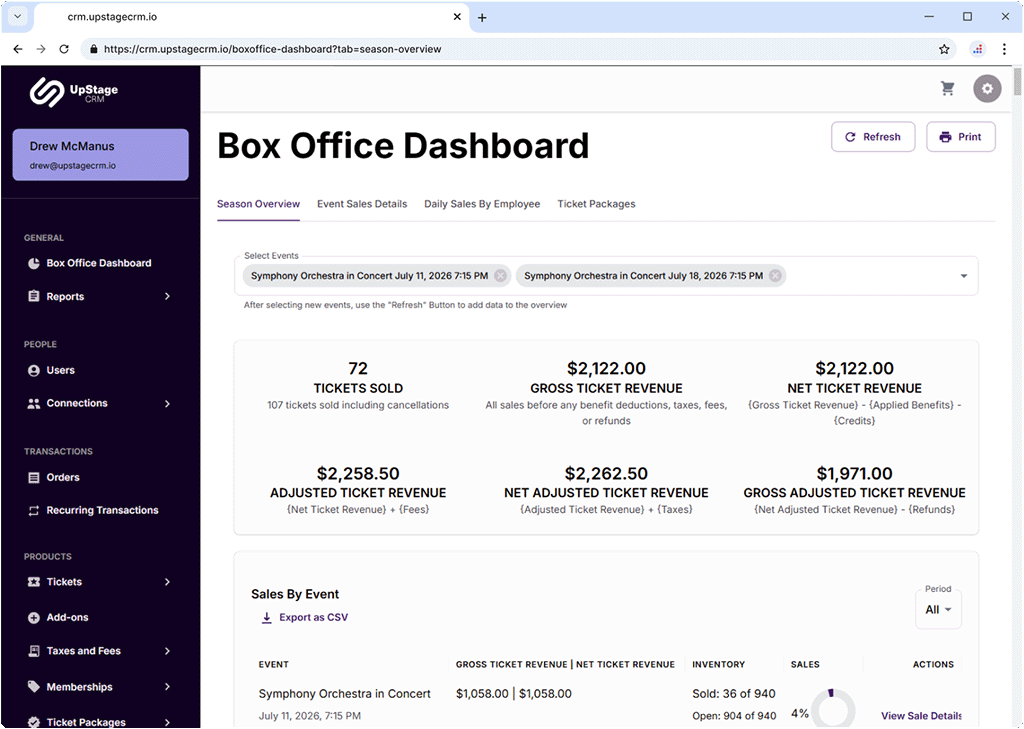
Because it applies to every individual ticket in every order, not to the order as a whole. A group buying four tickets triggers four separate $0.99 charges before a single payment processing fee is calculated. For an organization selling 800 to 1,000 tickets in a season, the software usage fee alone exceeds $800 annually: predictable, compounding, and entirely separate from what you’d pay UpStage, which charges one flat rate per transaction regardless of how many tickets are in the cart.
Switching is work. UpStage won’t pretend otherwise. What the process actually involves: no migration fee, guided onboarding that runs weeks rather than months, and your patron data, transaction history, and giving records travel with you. Because UpStage is one platform rather than two, your staff learns one interface. The disruption is real but it is decidedly finite. The alternative is staying on a platform that costs more, does less, and answers to someone else’s priorities indefinitely.
Experience matters. What also matters is what happened after Arts People was acquired by Neon One. Organizations that used Arts People before the acquisition have publicly noted fee increases that were not matched by improvements in software capability or support quality. A long history under new ownership, with investor-driven growth priorities, is not the same as continuity of mission. UpStage is built exclusively for performing arts organizations and operates without the pressure of satisfying institutional investors whose interests don’t necessarily align with a small nonprofit’s long-term needs.
Neon One is backed by FTV Capital and Blue Star Innovation Partners. That matters because institutional investors don’t back software companies out of passion for the nonprofit arts sector: they back them to generate a return. That return comes from one of two places: growing revenue or selling the company. Growing revenue means raising prices, adding fees, or cutting costs that currently go toward support and development. Selling the company means your platform, your patron data, and your contract land with whoever buys them. UpStage is independently owned and operated. Our roadmap answers to performing arts organizations, not to investors with an exit timeline.
More informationYour patron data belongs to your organization, full stop. UpStage does not sell, share, or monetize patron information, and you can export everything at any time. UpStage’s founding philosophy is user-owned business: the relationship between your organization and your patrons is yours to keep regardless of what happens at the platform level and our agreements protect that relationship. That’s a meaningful question to ask of any platform you’re evaluating, particularly one backed by institutional investors with their own exit timelines.
UpStage is the strongest alternative for nonprofit performing arts organizations because it was purpose-built for exactly that context. Ticketing, fundraising, donor management, membership, and reporting are all included out of the box, with no second subscription required and no overnight sync holding your data hostage. Where Arts People became a piece of a larger general-nonprofit platform after its acquisition, UpStage was designed from the start around the specific way performing arts organizations sell tickets, cultivate donors, and run their seasons.
It’s a fair question. UpStage was built from the ground up for nonprofit performing arts organizations, which means every feature, every workflow, and every support conversation reflects the specific context your organization operates in. Newer does not mean untested: it means you’re not inheriting fifteen years of technical debt, a product acquisition, or a pricing model designed for an investor’s return. The question worth asking is not how long a platform has existed but whether it was built for you.
UpStage is built for nonprofit performing arts organizations, not for organizations above a certain revenue threshold. Small choruses, chamber ensembles, and community theaters use the same platform as larger regional companies. The annual license is flat, the features are the same regardless of your size, and there are no transaction fees that compound as your ticket volume grows. Smaller organizations benefit more from that structure, not less.
That reputation comes from platforms that connect two separate products and call it an integration. Arts People / Neon One is exactly that: two subscriptions, two interfaces, and an overnight sync that means today’s ticket sales don’t appear in your donor records until tomorrow. UpStage is not an integration. It is one platform where ticketing, donations, patron records, and fundraising tools share the same data in real time. There is nothing to sync because there is nothing separate.
UpStage’s roadmap is driven by the performing arts organizations on the platform. If a feature you need does not exist yet, the conversation about building it starts with your use case, not with whether it fits a product vision designed for the entire nonprofit sector. That said, review the feature list carefully before any decision: UpStage covers the full range of ticketing, donor management, fundraising, reporting, and patron engagement tools that nonprofit performing arts organizations rely on.