
Three Big Reasons to Choose UpStage Over Spektrix
One Patron. One Record. No Exceptions.
Spektrix has a thing with duplicate patron records and there’s no solution: conflicting transaction histories, donor data you cannot fully trust, and staff hours spent on cleanup that should have gone toward your next production.
UpStage is dupe-free thanks to using each patron’s email address as a unique system-wide identifier, making duplicate records structurally impossible (don’t worry, we handle no-email users with equal ease). When your box office or development team pulls a patron record, they are looking at one complete, accurate picture of that person’s relationship with your organization, not a list of possible matches to reconcile.
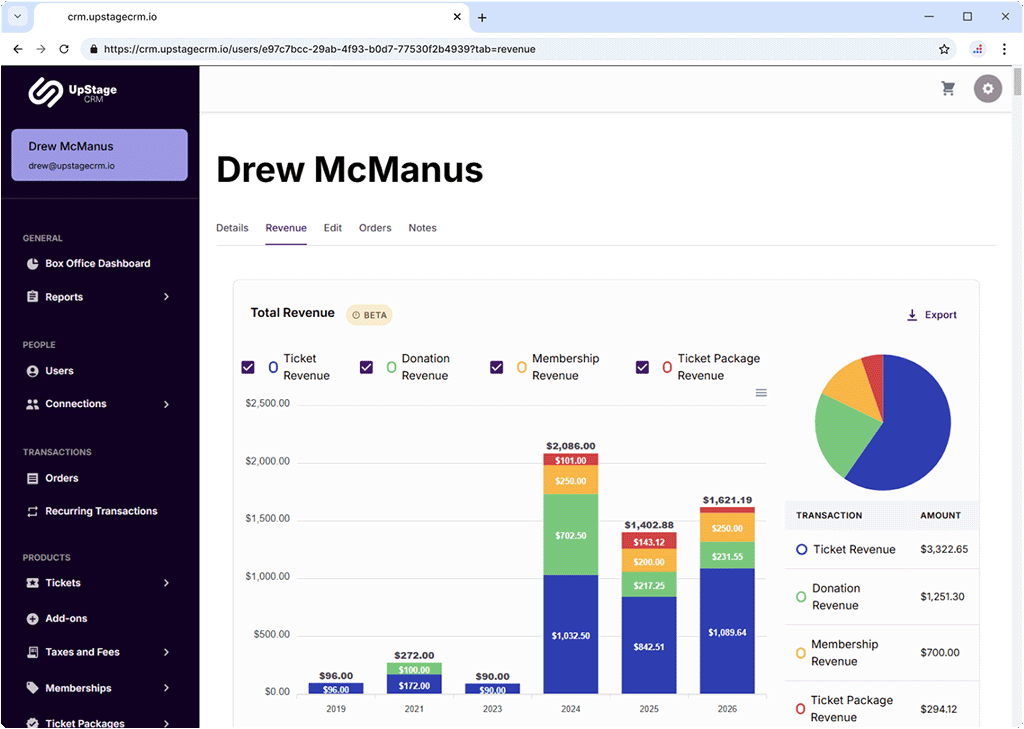
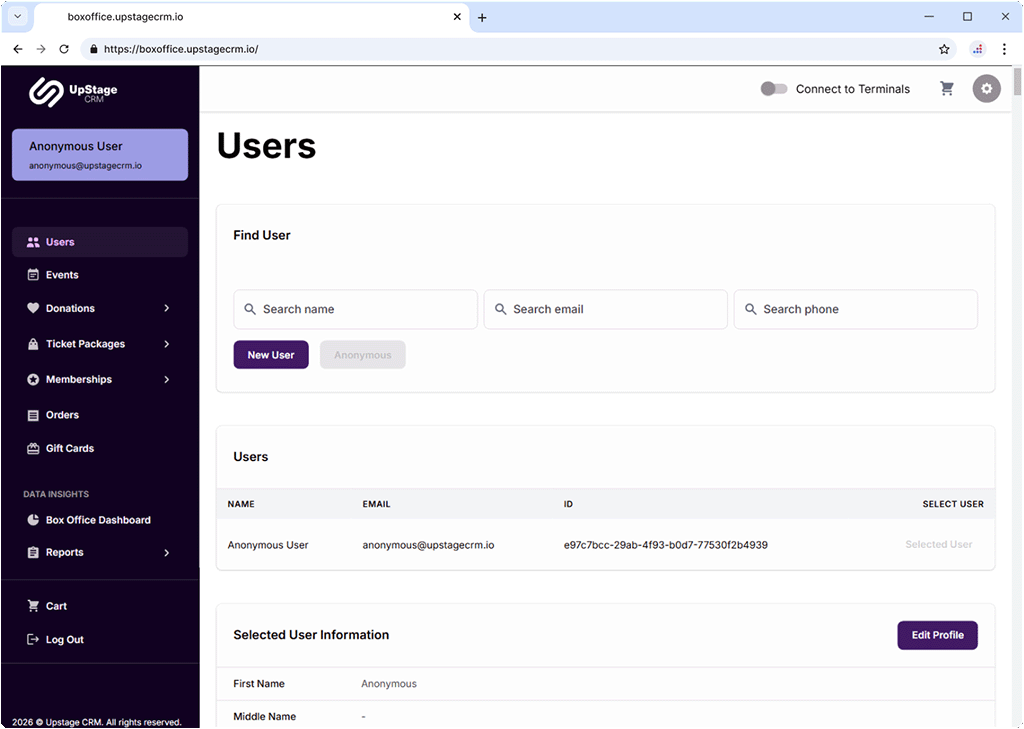
Your Box Office Staff Are Not IT Professionals
Spektrix users consistently describe a steep learning curve, with staff members who lack technical backgrounds finding the system intimidating even after extended use. Sessions timeout on inactivity without saving. The browser back button navigates users off the page entirely. Routine tasks require multi-step processes.
UpStage was designed for the actual people running nonprofit performing arts box offices: fuzzy patron search by partial name or email domain, a built-in one-click anonymous user account for walk-up sales, and a box office environment that does not demand a technical background to operate confidently on opening night.
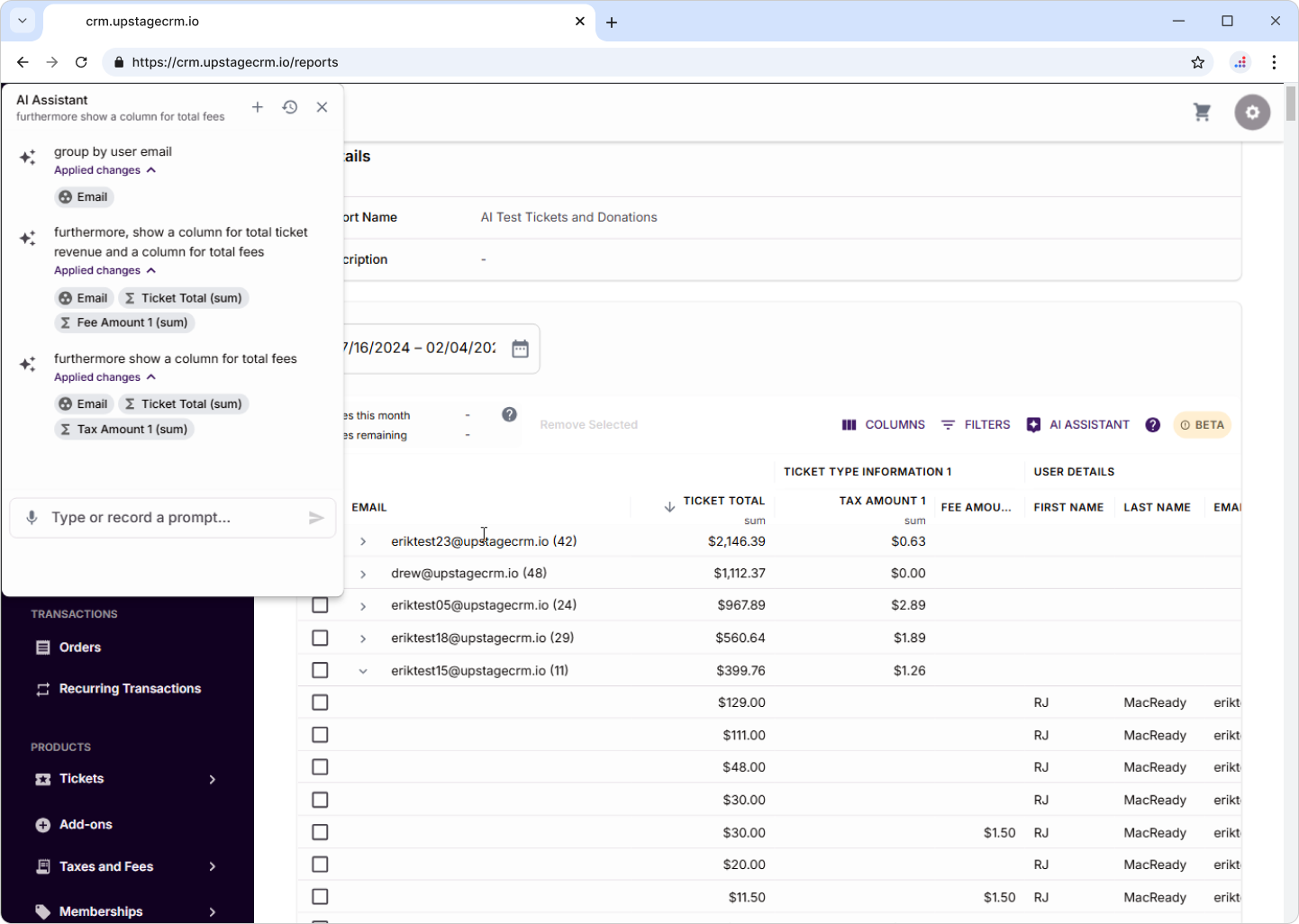
Stop Exporting. Start Analyzing.
Spektrix exports reports to Excel and CSV. There is no way to click from a report result directly to a patron record inside the system. Customer list tag filtering pulls all tags at once, not one, requiring manual cleanup after every export. Fundraising campaign totals require manually summing sub-campaigns. A patron’s giving history within a fiscal year is not a standard profile field; it requires building and running a report.
UpStage keeps all of this inside the platform: click a report result and you are on the patron record, filter to a single tag, see campaign rollup totals at a glance, and find fiscal year giving directly on the patron profile. All while building complex pivot tables in seconds with our AI Reporting Assistant.
Features & Costs. Compared.
Table A: Feature Comparison
Cost Element

Table B: Total Cost of Ownership
Spektrix’s service charge is a percentage of ticket revenue billed monthly; the exact rate is not publicly disclosed and varies by organization. Card processing fees are billed separately. Web integration requires a developer at the organization’s expense. We’re confident our pricing is not only competitive, but better! All rows below reflect what Spektrix publishes publicly and what their own support documentation confirms. The following data is based on information available at time of publishing.
Cost Element
Organizations That Made The Move

Long Beach Opera, short patron experience
In our Box Office, we are able to provide an experience just like one you’d find at Sofi Stadium or the Regency Village Theatre. The customized seating maps let us give our patrons more information when making their seating choices. With Upstage, we’ve gained the confidence to move away from the antiquated subscription model, which research shows is becoming less and less popular with contemporary audiences, and into the world of customized ticket packages. Our Opera patrons are now afforded the flexibility to create custom ticket packages, mixing and matching shows that fit their schedule and interests.
Patron Portal Demo
Personalized Platform Demo
Answers Without The Sales Spin
Spektrix took a sizale private equity investment from Foresight Group in 2019, which took a key equity stake in the company. Foresight is a listed infrastructure and private equity fund manager. This means the organization now has a capital partner whose interests are financial return. Product priorities, pricing decisions, and growth strategy all happen in that context. UpStage has no outside investors and no plans to take them on. The platform’s direction is set by what nonprofit performing arts organizations need, full stop.
Switching is work. UpStage won’t pretend otherwise. What the process actually involves: no migration fee, guided onboarding that runs weeks rather than months, and your patron data, transaction history, and giving records travel with you. Because UpStage is one platform rather than two, your staff learns one interface. The disruption is real but it is decidedly finite. The alternative is staying on a platform that costs more, does less, and answers to someone else’s priorities indefinitely.
Support, training, and upgrades are included in the service charge, which is a genuine advantage over vendors who bill for those items separately. What is not included: card processing fees, billed separately as a percentage of every transaction; web integration, which requires thousands of dollars in initial integration costs and ongoing legacy maintenance costs; and overage surcharges, which apply when your ticket sales exceed your tier’s inclusive annual allowance. UpStage has no overage fees. If your organization has a strong season and sells more than expected, your cost does not change that year. The difference matters most when your work is going well.
Scale proves adoption, not fit. Spektrix serves producing theaters, presenting venues, arts centers, festivals, music venues, and entertainment companies. Its reporting architecture, pricing structure, and product priorities reflect that breadth. For several years, they didn’t have competitors to provide better alternatives. Now they do. UpStage was built for one kind of organization: nonprofit performing arts. Every feature exists because these organizations cannot function well without it. That specificity is not a limitation. It is the point.
That concern is exactly why UpStage is designed the way it is. Spektrix users consistently describe a steep learning curve, with staff members who lack technical backgrounds finding the system intimidating even after extended use. UpStage’s box office environment was built for the people who actually run performing arts operations: fuzzy patron search that does not require an exact email address, anonymous transaction processing for walk-up patrons, and a session environment that does not timeout and discard in-progress work. The boxoffice sales experience is nearly identical to the one patrons use so there’s no need to learn two systems for the same process.
Spektrix includes a Dotdigital license as part of its service charge. UpStage integrates directly with Mailchimp and our users pay Mailchimp directly for those services. For most nonprofit performing arts organizations already running patron communications through Mailchimp, your existing lists, templates, and workflows carry forward without rebuilding inside a new tool so there are no additional costs. If your organization is evaluating email platforms, that is worth a direct conversation during your UpStage demo.
Yes. UpStage includes native grant tracking and pledge tracking. Campaigns track goals and revenue in real time. Individual pledges attach directly to campaigns and appear in revenue reports. For organizations currently running development operations across Salesforce, spreadsheets, and disconnected ticketing data, a consolidated platform is not a convenience; it is a fundamental change in how your team works.
UpStage’s roadmap is driven by the performing arts organizations on the platform. If a feature you need does not exist yet, the conversation about building it starts with your use case, not with whether it fits a product vision designed for the entire nonprofit sector. That said, review the feature list carefully before any decision: UpStage covers the full range of ticketing, donor management, fundraising, reporting, and patron engagement tools that nonprofit performing arts organizations rely on.
Your data belongs to your organization. UpStage was built on the principle of user-owned business, not platform lock-in. Your patron records, transaction history, and organizational data are exportable at any time. That is not a policy created in response to competitive pressure. It is a founding commitment built into how the platform was designed from the beginning.