
Three Big Reasons to Choose UpStage Over CueBox
Every Dollar Stays in Your Hands
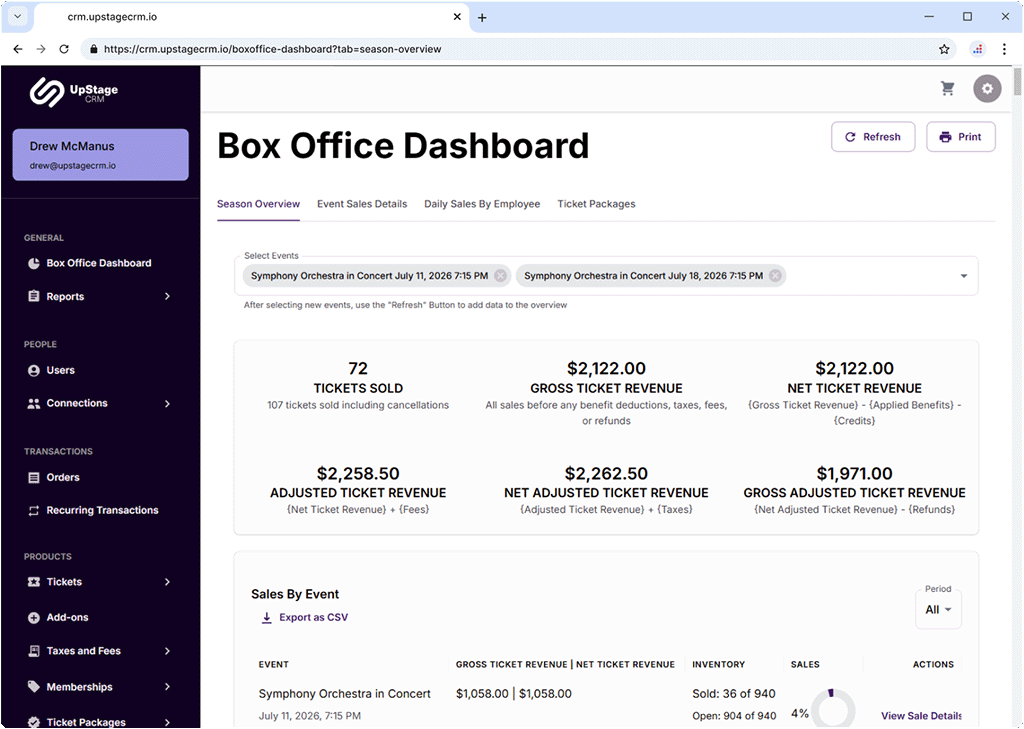
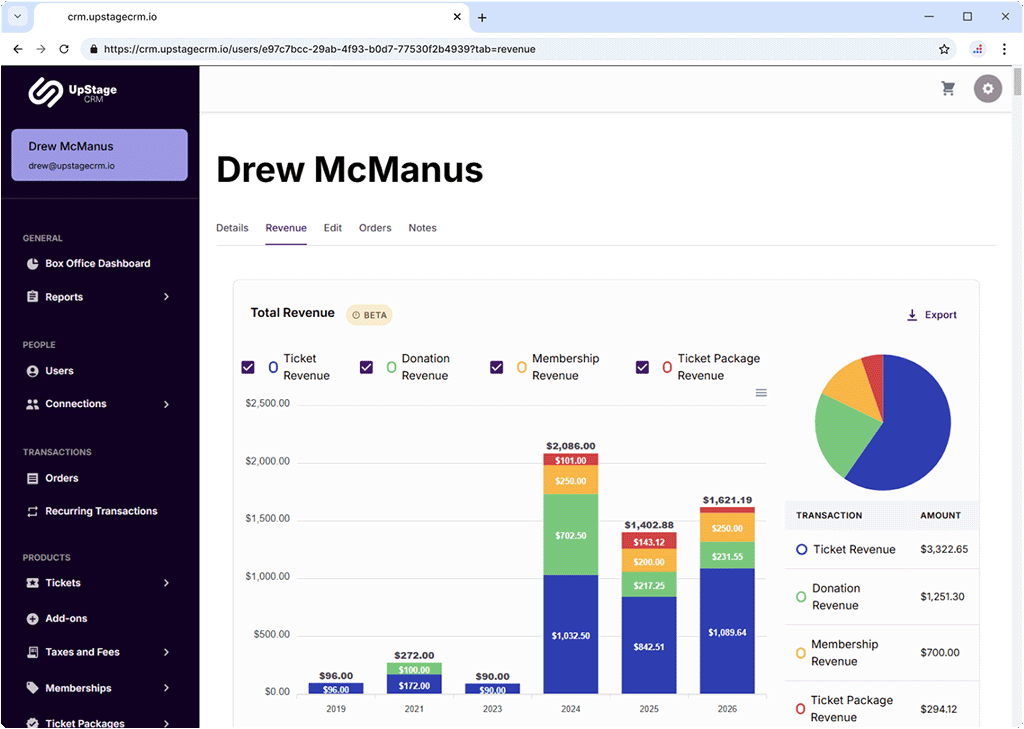
CueBox processes payments through its own integrated gateway, meaning your revenue passes through their system before it reaches your bank account. UpStage connects directly to a Stripe account your organization owns, so ticket and donation revenue lands in your bank on your schedule with no intermediary. You see every transaction in real time, control your own refund policies, and never wonder where your money is between sale and deposit.
Freedom to Stay Because You Want To
CueBox requires a multi-year initial commitment, locking your organization into a contract that outlasts most strategic plans. UpStage earns your renewal every year with flexibility after your first annual term to choose a multi-year agreement if it’s something you want. If your needs change or your budget shifts, you adapt without penalty; that is the kind of partnership a nonprofit deserves.
One Platform, No Workarounds
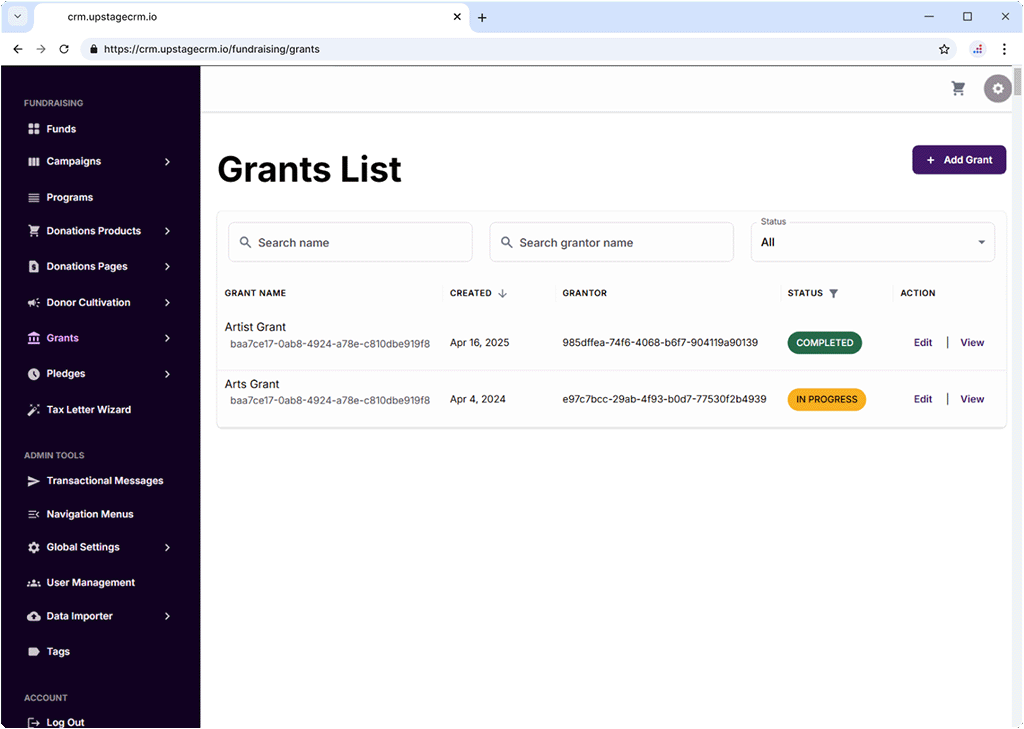
CueBox has no dedicated grant tracking module, leaving development teams to repurpose pledge tools or maintain separate spreadsheets. UpStage includes purpose-built grant tracking alongside pledges, campaigns, and tax letter generation so your fundraising data lives in one place. When your board asks for a consolidated view of contributed revenue, you pull one report instead of stitching three systems together.
Features & Costs. Compared.
Table A: Feature Comparison
Cost Element

Table B: Total Cost of Ownership
Based on $61,000 in annual ticket sales (approximately 813 tickets) and $55,000 in annual donations (approximately 550 gifts). The following data is based on information available at time of publishing.
Cost Element
Organizations That Made The Move

Long Beach Opera, short patron experience
In our Box Office, we are able to provide an experience just like one you’d find at Sofi Stadium or the Regency Village Theatre. The customized seating maps let us give our patrons more information when making their seating choices. With Upstage, we’ve gained the confidence to move away from the antiquated subscription model, which research shows is becoming less and less popular with contemporary audiences, and into the world of customized ticket packages. Our Opera patrons are now afforded the flexibility to create custom ticket packages, mixing and matching shows that fit their schedule and interests.
Patron Portal Demo
Personalized Platform Demo
Answers Without The Sales Spin
Yes. UpStage integrates with Mailchimp and lets you export tagged patron segments directly, so your email lists stay current without manual data pulls. The difference is how segmentation works upstream: UpStage gives you granular tagging at the user, product, and transaction level so the lists you send to Mailchimp are sharper before they ever leave the CRM. You can also push segmented lists directly into Mailchimp without the export/import hassle!
Switching is work. UpStage won’t pretend otherwise. What the process actually involves: no migration fee, guided onboarding that runs weeks rather than months, and your patron data, transaction history, and giving records travel with you. Because UpStage is one platform rather than two, your staff learns one interface. The disruption is real but it is decidedly finite. The alternative is staying on a platform that costs more, does less, and answers to someone else’s priorities indefinitely.
No. UpStage is independently owned by its co-founders and does not answer to outside investors. CueBox, by contrast, is a venture-backed company that has raised outside funding. Venture backing creates pressure to grow revenue, raise prices, or pursue an acquisition; that pressure flows downhill to the organizations paying the bills. UpStage’s ownership structure means pricing decisions, feature priorities, and support commitments are driven by client needs, not investor return timelines.
More informationPassion for the arts matters, but so does exclusive focus. CueBox is a venture-backed startup serving performing arts alongside broader cultural organizations. UpStage was built exclusively for nonprofit performing arts: theaters, orchestras, opera companies, and choruses by professionals with more than 75 combined years of arts admin experience. That focus shows in features like grant tracking, multi-rule early access, and AI-assisted reporting designed for the specific operational patterns of a season-based performing arts organization.
Not at all, in fact, smaller organizations often get the most value from UpStage because it replaces the patchwork of separate tools: one for ticketing, one for donations, one for email, one for the website. Instead of paying for and managing four or five services, you have one platform and one relationship. The interface is designed for teams that do not have a dedicated IT department.
CueBox reserves the right to change processing fees at any time with written notice. For an organization budgeting a full season of ticket sales and fundraising campaigns, unpredictable fee changes introduce real financial risk. UpStage locks your transaction fee rate for the term of your agreement, so the numbers in your budget stay the numbers in your bank account.
Yes. UpStage includes native grant tracking and pledge tracking. Campaigns track goals and revenue in real time. Individual pledges attach directly to campaigns and appear in revenue reports. For organizations currently running development operations across Salesforce, spreadsheets, and disconnected ticketing data, a consolidated platform is not a convenience; it is a fundamental change in how your team works.
UpStage’s roadmap is driven by the performing arts organizations on the platform. If a feature you need does not exist yet, the conversation about building it starts with your use case, not with whether it fits a product vision designed for the entire nonprofit sector. That said, review the feature list carefully before any decision: UpStage covers the full range of ticketing, donor management, fundraising, reporting, and patron engagement tools that nonprofit performing arts organizations rely on.