
Three Big Reasons to Choose UpStage Over Ludus
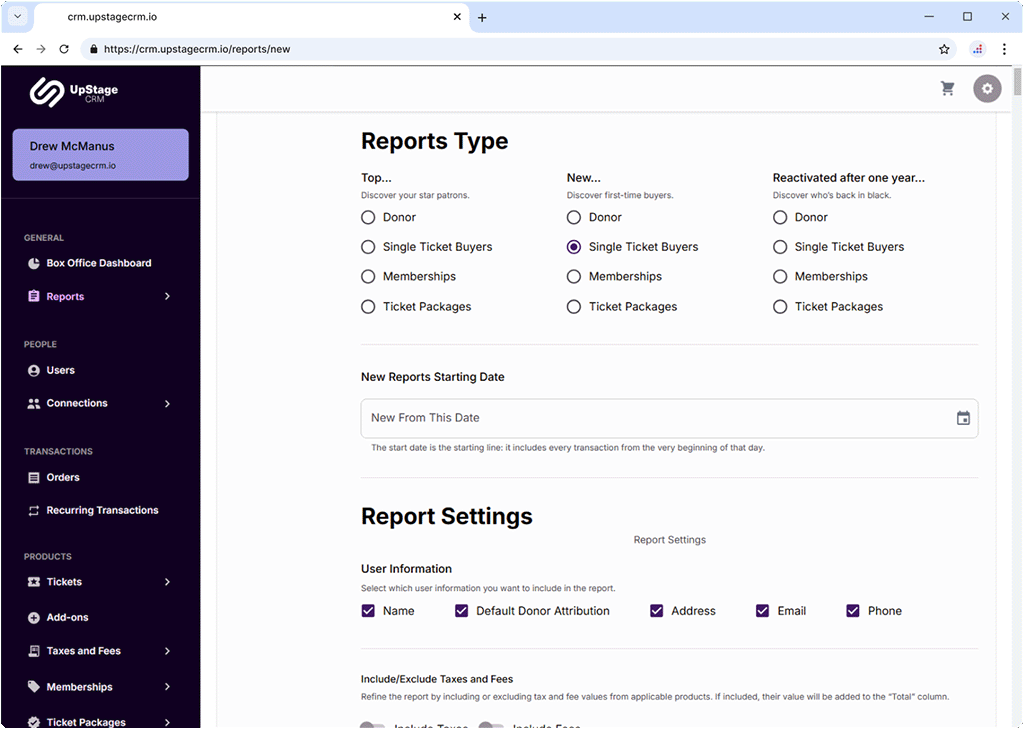
Know Who’s Coming Back and Who Isn’t
Without first-time buyer, repeat buyer, lapsed buyer, and reactivated buyer reports, your team is making season-planning and development decisions without the data those decisions require. What does it cost your organization when you can’t identify which patrons haven’t returned in two seasons?
UpStage includes all four reports as standard, paired with AI-assisted tools that allow you to easily identify any patron segments you’re looking for. No third-party software, no manual exports, no guesswork.
The More You Use It, the More It Costs
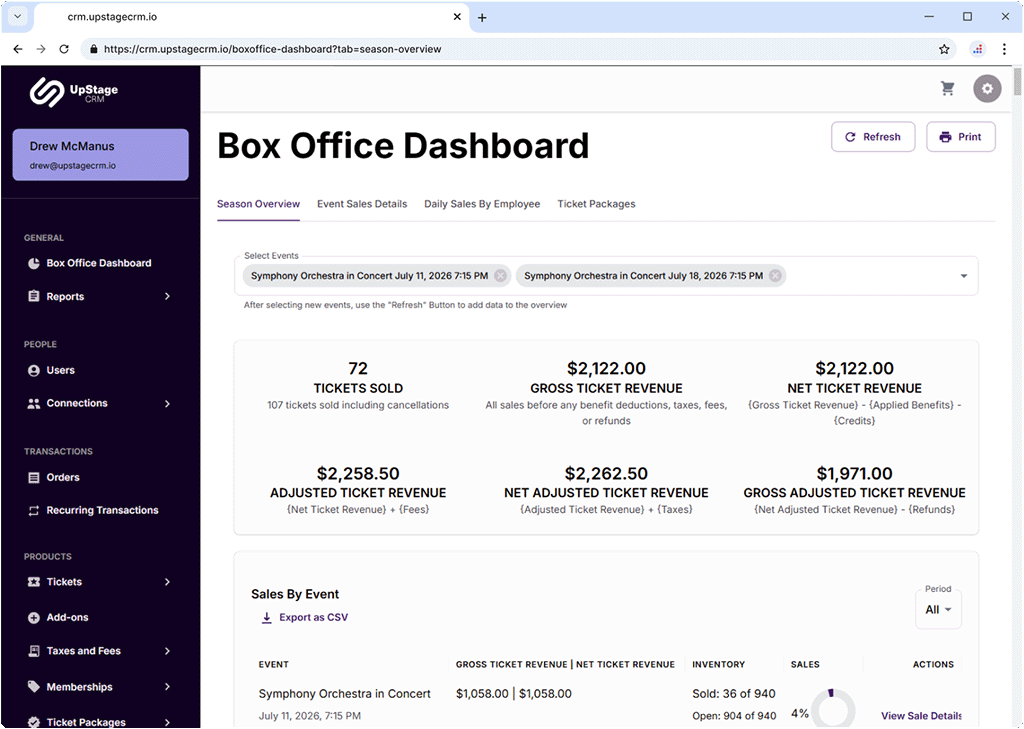
Ludus’ pricing is not a single number. Every feature tier you need adds to your per-transaction cost: the embeddable ticket widget, email marketing tools, and class management each add $0.05 per transaction on top of a base rate that is already the highest of any platform in a direct competitive evaluation. The more your organization actually uses the platform, the more you pay per ticket. And don’t miss that Ludus reserves the right to adjust that entire fee structure on 90 days’ notice.
UpStage operates on a different philosophy: every feature a performing arts organization needs to do its job is included at the same price. No painful upsell because you need basic features. Critical functionality is default functionality. The moment you need a feature is not the moment you should be reading a pricing page.
One Platform, No Workarounds
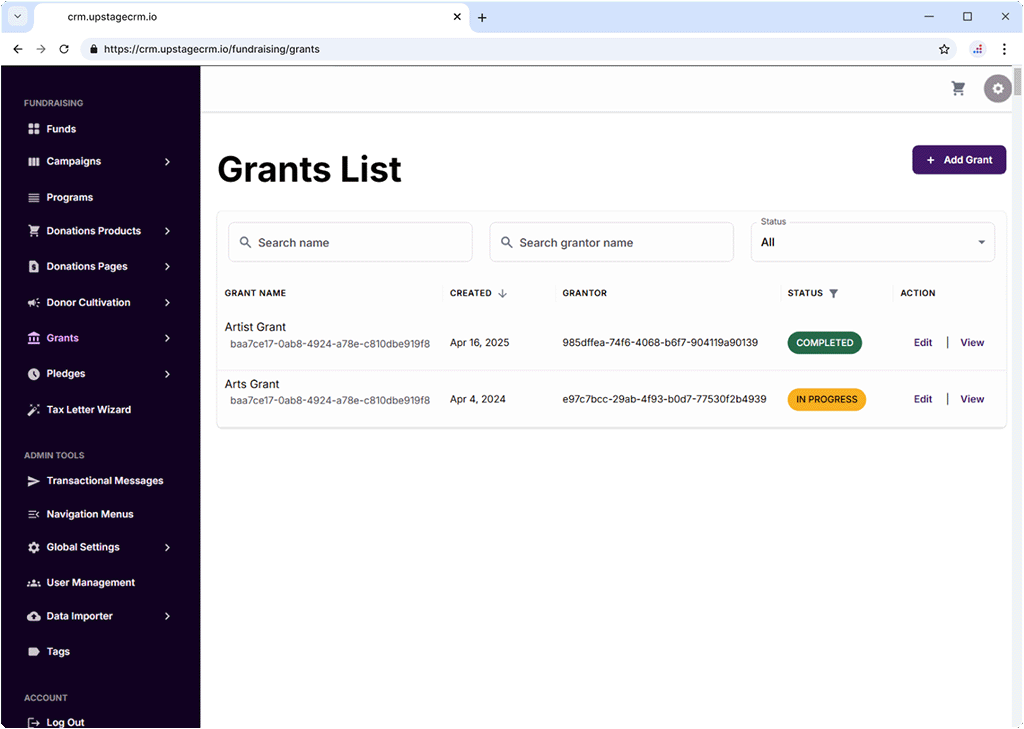
Pledge tracking, grant tracking, Mailchimp integration, a dedicated box office app with QR scanning, account codes per product, and one-page donation checkout: all of these are standard in UpStage. In Ludus, they are either absent or require a customization request with no guaranteed timeline.
Every gap in Ludus becomes a workaround your team absorbs: another spreadsheet, another disconnected vendor, another hour that should have gone toward your other critical tasks. UpStage consolidates all of it, and none of it requires a customization request.
Features & Costs. Compared.
Table A: Feature Comparison
Cost Element

Table B: Total Cost of Ownership
Based on $61,000 in annual ticket sales and $55,000 in annual donations. Third-year projection assumes the same annual volume with no fee increases and no Ludus fee adjustments. The following data is based on information available at time of publishing.
Cost Element
Organizations That Made The Move

National Music Festival
It has been a pleasure working with Drew McManus, the UpStage team, and within their system. Communication and messages are always prompt throughout the year, and special attention and support is given by the team at the beginning of each of our seasons to ensure everything runs smoothly.
Patron Portal Demo
Personalized Platform Demo
Answers Without The Sales Spin
Only if you look at one line item in isolation. In place of a flat annual fee, Ludus charges 5% plus $0.75 per ticket and 3.5% plus $0.50 per donation. On $116,000 in combined annual sales, that’s $6,541 in transaction fees versus $3,773 with UpStage. Add a separate website provider at anywhere from a few hundred to a several thousand per year, and Ludus’ apparent cost advantage is gone before the end of Year 1.
Switching is work. UpStage won’t pretend otherwise. What the process actually involves: no migration fee, guided onboarding that runs weeks rather than months, and your patron data, transaction history, and giving records travel with you. Because UpStage is one platform rather than two, your staff learns one interface. The disruption is real but it is decidedly finite. The alternative is staying on a platform that costs more, does less, and answers to someone else’s priorities indefinitely.
It was accurate when they said it. but in May 2025, Ludus accepted growth equity financing from Mamba Growth Equity, a firm based in Stamford, Connecticut. Growth equity investment introduces a new principal with financial return expectations into every pricing, product, and operational decision Ludus makes going forward. UpStage has no outside investors and no plans to take them on. The platform’s direction is determined by what nonprofit performing arts organizations need, not by what a capital partner needs to return.
More informationYes. UpStage includes a direct Mailchimp integration. You can export tagged patron segments directly into Mailchimp for targeted campaigns. Ludus does not offer Mailchimp integration.
Users can submit and upvote ideas, but Ludus’ own materials confirm the roadmap is strictly determined and controlled by the Ludus team. That was a limited distinction before May 2025. Now that Mamba Growth Equity has invested a controlling interest, there is a dominant party in that conversation whose interests are driven solely by their financial interests. UpStage was built exclusively for nonprofit performing arts organizations, and every feature in the platform exists because these organizations cannot function well without it. We don’t build software to make money, we make money to build software.
Your data belongs to your organization. UpStage was built on the principle of user-owned business, not platform lock-in. Your patron records, transaction history, and organizational data are exportable at any time. That’s not a policy created in response to competitive pressure; it’s a founding commitment built into how the platform was designed.
Yes. UpStage includes native grant tracking and pledge tracking. Campaigns track goals and revenue in real time. Individual pledges attach directly to campaigns and appear in revenue reports. For organizations currently running development operations across Salesforce, spreadsheets, and disconnected ticketing data, a consolidated platform is not a convenience; it is a fundamental change in how your team works.
UpStage’s roadmap is driven by the performing arts organizations on the platform. If a feature you need does not exist yet, the conversation about building it starts with your use case, not with whether it fits a product vision designed for the entire nonprofit sector. That said, review the feature list carefully before any decision: UpStage covers the full range of ticketing, donor management, fundraising, reporting, and patron engagement tools that nonprofit performing arts organizations rely on.