Three Big Reasons to Choose UpStage Over PatronManager
When The Annual Fee You Sign Is Not The Price You Pay.
Apparently, the annual fee isn’t enough since PatronManager charges separately for everything you need to actually use the platform: users, storage, training, support (!?!), API calls, and even a fee for every patron that logs into their account to access tickets.
PatronManager requires every client organization to designate and maintain a certified internal platform administrator, with formal training completed on a tight timeline. If that person leaves, the organization must replace them on a similar schedule or absorb hourly penalty fees for support that exceeds a set monthly threshold. That is a staffing obligation built into the contract. UpStage does not require a dedicated platform administrator, mandatory certification, or any internal training credential. Your staff runs the box office; we handle the platform.
Workarounds Aren’t Features
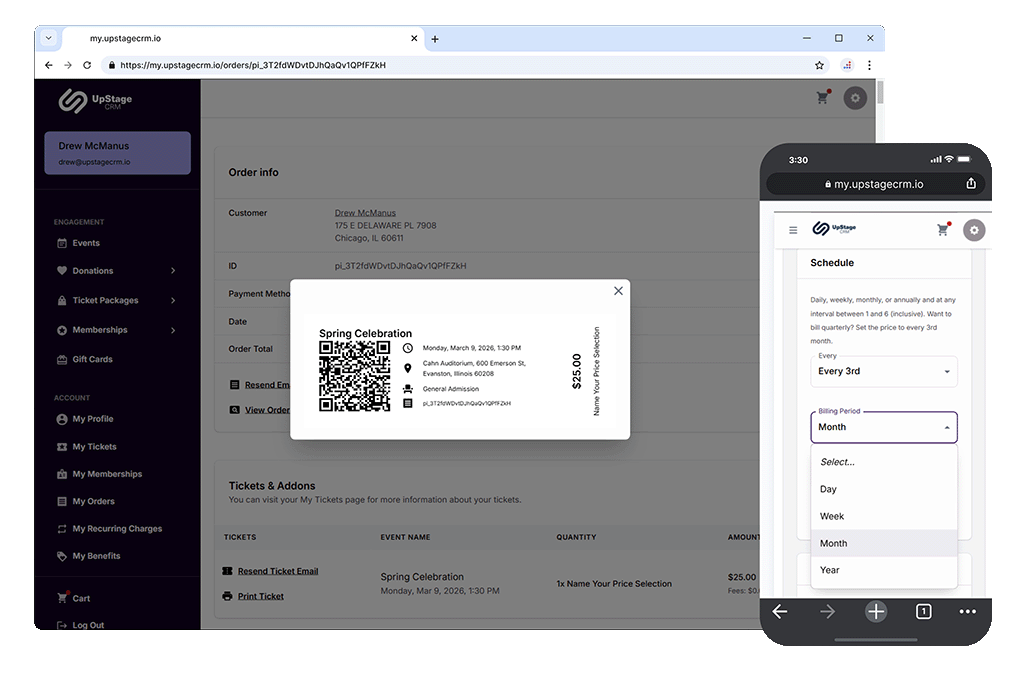
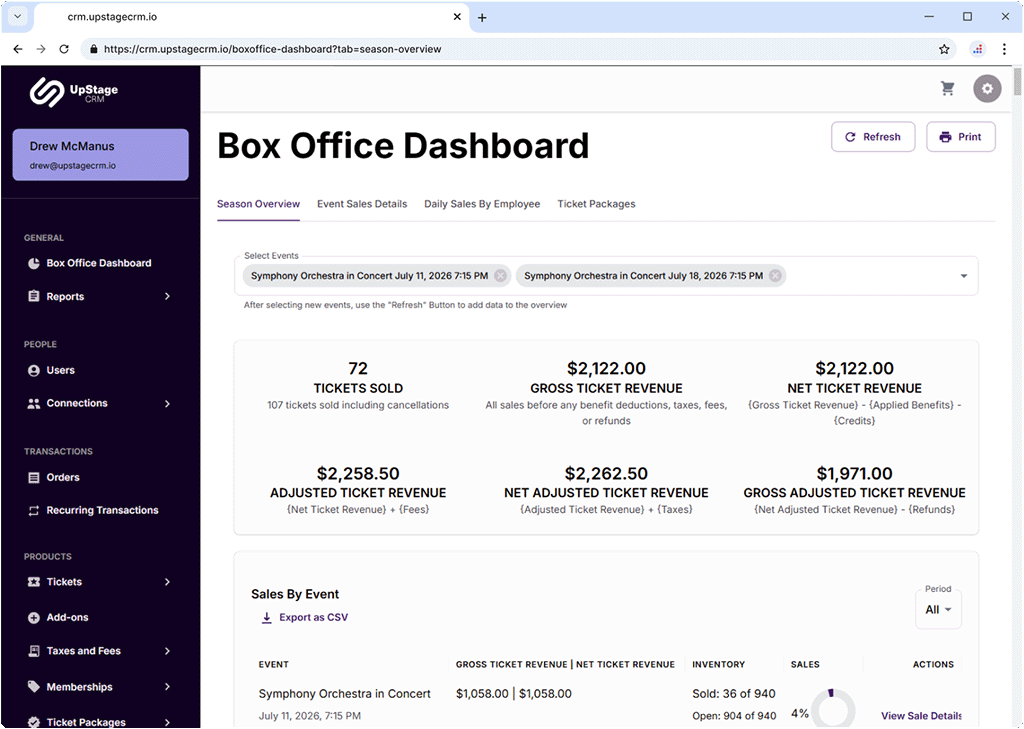
PatronManager is built on Salesforce, a platform designed for enterprise sales teams. Every performing arts capability it offers exists because someone engineered a workaround to make a sales CRM behave like a box office. That’s not a foundation; it’s a ceiling.
Your subscription logic, your seating configurations, your donor relationships: all of it runs inside a system that was never designed for any of it, which means every improvement PatronManager makes is constrained by what Salesforce will allow. UpStage was built from the first line of code for nonprofit performing arts organizations. There’s nothing to work around.
Your Reports Should Answer Questions, Not Create Them
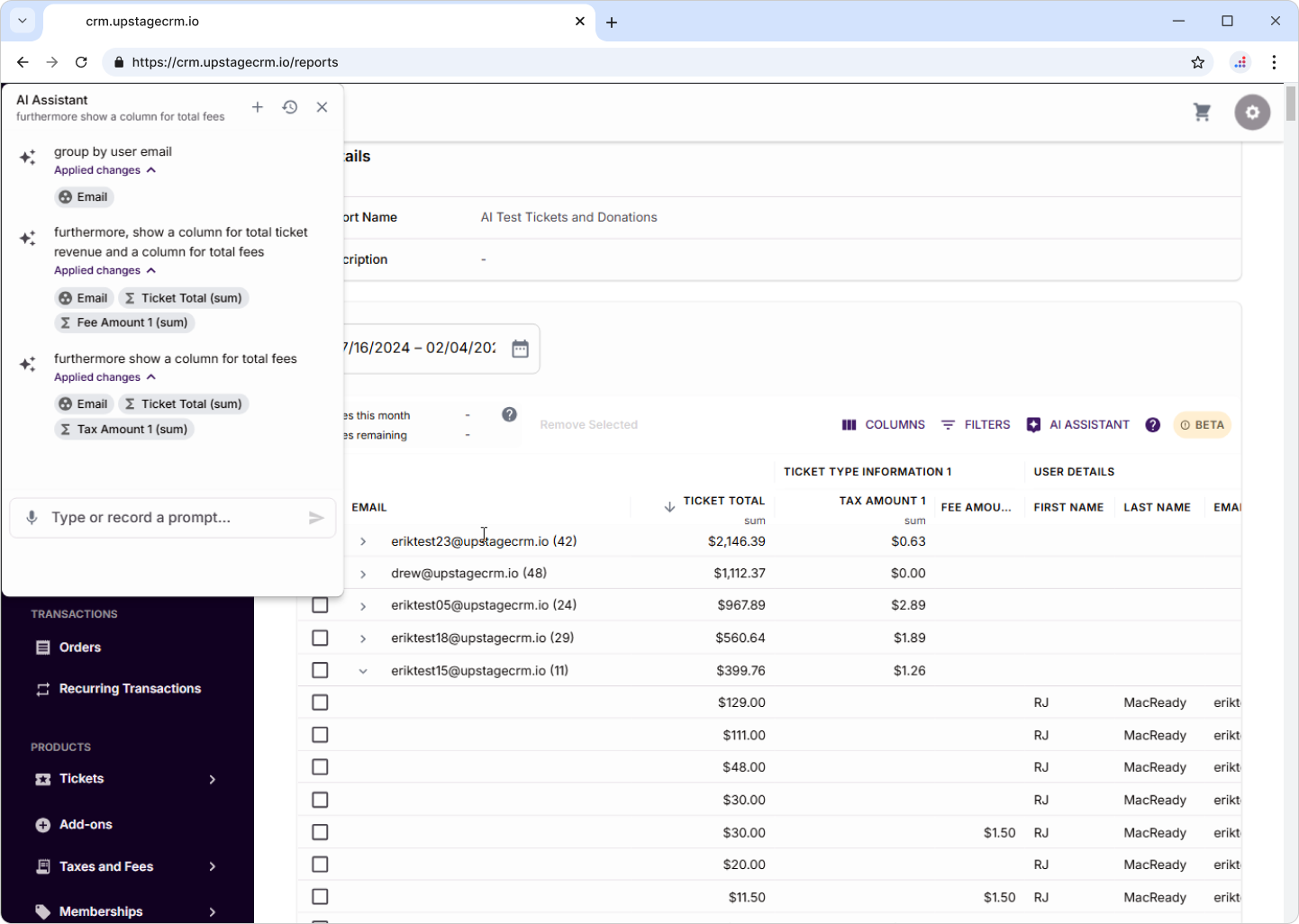
Reporting inside a Salesforce-based platform means your data lives in a structure designed for enterprise sales teams using a complex SQL based query structure. Getting a straightforward answer about your season’s performance can require Salesforce-level expertise just to ask the right question.
UpStage reporting is built for performing arts organizations, with AI-assisted tools that work the way your staff thinks, not the way a CRM vendor’s engineers do. Just ask and UpStage answers. No data science PhD required.
Features & Costs. Compared.
Table A: Feature Comparison
Cost Element

Table B: Total Cost of Ownership
Based on an organization with ~$700,000 per year in ticket, subscription, and membership revenue, 10 admin users, and 7,775 patrons signing into their account. But really, that’s just for PatronManager since they charge extra for the latter items. In UpStage, they are included.
Cost Element
Organizations That Made The Move

National Music Festival
It has been a pleasure working with Drew McManus, the UpStage team, and within their system. Communication and messages are always prompt throughout the year, and special attention and support is given by the team at the beginning of each of our seasons to ensure everything runs smoothly.
Patron Portal Demo
Personalized Platform Demo
Answers Without The Sales Spin
It isn’t inherently, but it does mean your organization is managing two platforms. Salesforce is a general-purpose enterprise CRM; PatronManager is an arts-specific layer built on top of it. That creates two sets of licensing terms, two sets of update cycles, and a system that was not originally designed for box office ticketing. UpStage is a single platform built for exactly what you do. There is no underlying CRM to configure, no secondary vendor relationship to manage, and no feature gaps where the two systems don’t quite fit together.
It’s worth understanding what the acquisition signals. Ticketure’s core market is timed-entry and general admission ticketing for museums, zoos, aquariums, and similar venues. PatronManager’s core market is performing arts organizations with reserved seating, subscriptions, and donor stewardship. Those are meaningfully different products and audiences. Acquisitions by private equity-backed buyers typically prioritize growth and return on investment, which can translate into pricing changes, feature consolidation, or a product roadmap that serves the acquirer’s broader portfolio rather than any one market segment. Whether this specific acquisition leads there is an open question. It’s simply the right question to ask before renewing a multi-year commitment.
More informationIt sounds bigger than it is, and that concern is worth naming directly. UpStage handles data migration as part of onboarding, and the process is structured to minimize disruption to your box office operations. Most organizations are up and running well before their next major season. The real question is what it costs to stay: transaction fees that compound on every ticket sale and donation across your entire season, every year.
No. Some platforms,like PatronManager, require clients to route all events through their ticketing system as a contractual condition, with only narrow exceptions. UpStage places no such restriction on your organization. You run your events the way you need to.
Yes. UpStage includes a direct Mailchimp integration. You can export tagged patron segments directly into Mailchimp for targeted campaigns. Ludus does not offer Mailchimp integration.
UpStage does not charge fees for lost chargebacks so you don’t need to be worried about becoming the target of chargeback fraud. PatronManger charges an administrative fee on top of every lost chargeback, meaning your organization absorbs the disputed amount plus an additional fee. UpStage, nor the Stripe payment gateway, charge administrative fees on chargebacks.
UpStage does not run on Salesforce, which means Salesforce-specific integrations do not apply. What UpStage offers instead is a platform with email marketing, fundraising, CRM, ticketing, and reporting all built natively, so you don’t need external integrations to do the things most organizations use Salesforce add-ons to accomplish.
Your data is yours at all times. Some platforms return data only in CSV format after termination, within a limited window, and with no guarantee that every modification the platform made to your records is captured in what comes back. UpStage gives you full ownership and access to your data in a usable format, without a countdown clock, unlike PatronManager.
Your data belongs to your organization. UpStage was built on the principle of user-owned business, not platform lock-in. Your patron records, transaction history, and organizational data are exportable at any time. That’s not a policy created in response to competitive pressure; it’s a founding commitment built into how the platform was designed.
Of course! Some platforms, like Salesforce, prohibit clients from taking screenshots or demonstrating the system to any third party without prior written permission. UpStage has no such restriction. Your platform is yours to use, share, and demonstrate as your organization sees fit. We can even set up third party admin access for your development or marketing consultants when needed.
Longevity and reliability are different things. PatronManager has an established client base, and that matters. But the platform has now changed ownership, and its strategic direction is tied to a company whose primary expertise is museum and attraction ticketing. UpStage has been built and maintained exclusively for nonprofit performing arts organizations since day one, by a team that doesn’t serve any other market. That focus compounds over time in ways that matter: features, support, and product decisions that are oriented entirely toward your context.
UpStage’s roadmap is driven by the performing arts organizations on the platform. If a feature you need does not exist yet, the conversation about building it starts with your use case, not with whether it fits a product vision designed for the entire nonprofit sector. That said, review the feature list carefully before any decision: UpStage covers the full range of ticketing, donor management, fundraising, reporting, and patron engagement tools that nonprofit performing arts organizations rely on.